
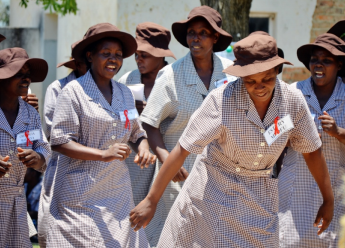
By: Dadirai Fundira and Katharine Shelley
Background
The Village Health Worker (VHW) Program in Zimbabwe was first adopted in 1980 when the country
transitioned to primary health care (PHC). VHWs are the first point of contact with the health system and
they focus on disease prevention by providing community care at the primary level in rural and peri-urban
wards.
Implementation
VHWs work with and among community groups, families, and individuals. They also work with community-
based volunteers and extension workers where they take the lead role. Approximately 60% of villages have access to a VHW.
Roles/Responsibilities
VHWs provide a comprehensive set of services, from health promotion to the provision of services to
referral to the next level of care at the local clinic or health center. They also are trained to diagnose and treat
common conditions such as diarrhea and malaria.
Training
The Ministry of Health and Child Care (MOHCC) conducts the training of VHWs. VHWs are trained for a
total of five months, including an initial 8-week classroom-based training followed by an 8-week practicum in
the field and then another 4-week in-class training at the end of the field training. Refresher trainings are
conducted twice a year or as needed and when funds are available.
Supervision
VHWs are directly supervised by the nurse-in-charge at the nearest health center within their ward. They
report monthly and quarterly to their local health center. They are also broadly supervised and supported by
community leaders and the Ward Health Team.
Incentives and remuneration
VHWs receive a quarterly allowance of US$ 42. However, payment is often irregular. They are also provided
with a uniform, bicycle, and a medical supply kit.
Impact
There has been no formal impact evaluation of the VHW Program itself, but the VHW Program does
provide a major portion of PHC services and is becoming recognized as an important contributor to the
improvement of several health indicators in the country. Evaluations of health projects in Zimbabwe have
shown consistently strong evidence of the contribution that VHWs have made to improving accessibility to
health care as well as a high level of appreciation from community members for the services provided by
VHWs.
Read more
Health for the People: National Community Health Worker Programs from Afghanistan to Zimbabwe
I am a community health worker in Gweru Urban. We are working on many programmes and we are promised a certain amount of allowances but we are not getting anything. If we ask the D.N.O , she doesn’t reply.We are not even getting masks or sanitizers, I don’t know who’s responsible for that.