
By: Ronald Ng'eno and George Nzioka
Originally posted on VillageReach here
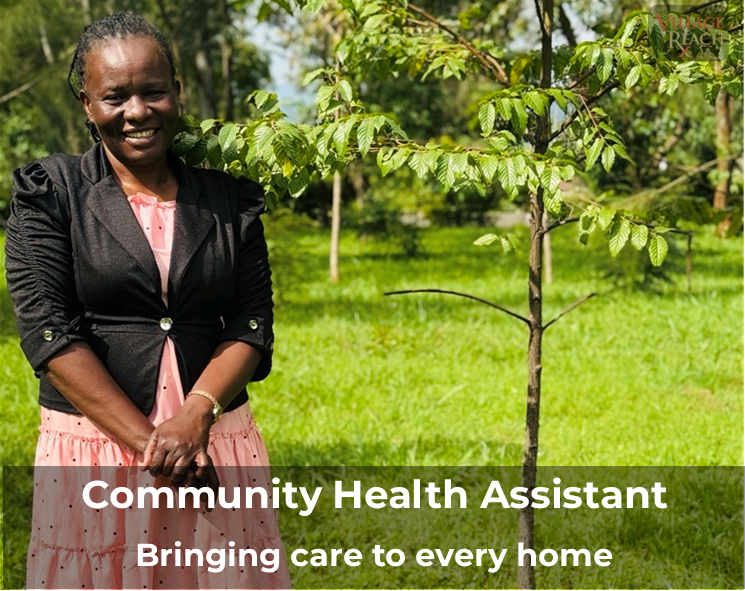
Beatrice wakes at sunrise in Migori County, her work plan already in hand. The work plan maps out neighbourhoods, lists caregivers and details the community health workers she will support today. “I don’t wear a white coat, but I bring hope,” she says, folding the plan with care. “People know I will come back and that changes everything.”
Beatrice Kagaya is a community health worker supervisor, also known as a community health assistant in Kenya. Based in Uriri sub-county, she oversees a network of community health workers who form the frontline of Kenya’s health system. These workers connect health facilities with households, delivering care where it is needed most. Beatrice has been a CHW supervisor since 2011; she describes it as a calling rather than a career shift. “It has always been in me to help community members lead healthy lives,” she told us in an interview in May 2025. Her pride and patience shine through, especially when the system falls short for those she serves.
Supervision that transforms care
Beatrice’s role is a mix of oversight and relational leadership. She manages 12 Community Health Workers (CHWs) and the local community health unit. This unit is the foundational structure of Kenya’s health system, serving about 5,000 people. On a typical day, she accompanies CHWs on household visits, observing them as they test for childhood illnesses, check for malnutrition and conduct malaria rapid diagnostic tests. Her mentorship and support supervision improve CHW’s skills, leading to improved quality of care. This work is crucial, as it builds and earns trust between the community and the health system.
“The biggest joy is seeing people change behavior,” she says. She points to an example that has become a hallmark of success: households that once lacked latrines are now building pit latrines; mothers who defaulted on immunization return to the clinic because CHWs find them door-to-door; a neighbor who repeatedly fell ill now knows that high blood pressure was the cause because a CHW tested her and referred her for care. “They come and say, ‘Doctor, you helped me,’ and that makes me happy,” she says.

Tools, training and persistent gaps
In recent years, Beatrice and her team have benefited from training in supply management and digital reporting, led by partners like VillageReach and Lwala Community Alliance. The training aims to build a resilient supply chain system that strengthens CHWs and ensures uninterrupted access to essential health services. The current efforts are focused on Migori, Homa Bay and Baringo Counties in Kenya and extend to the national level through collaboration with the Ministry of Health.
Through these trainings, CHWs learn how to use S11 forms (standard tools for requesting and tracking supplies from health facilities) to request routine replenishment of health products and bin cards for tracking their product use, which helps prevent stockouts. CHWs now record service delivery in the electronic Community Health Information System (eCHIS) on smartphones. This better stock visibility means better care for patients, as CHWs can order supplies before they run out.
Accountability is a key gain. Without documentation, health products that are lost, stolen or expired cannot be accounted for. Beatrice recalls a case where a community health worker faced blame for missing anti-malarials. S11 records showed who ordered what, who received it and when. “We proved the commodities were issued properly,” she says. This clarity avoided conflict and protected the worker and her community.
But despite these improvements, last-mile health workers like Beatrice still face challenges. Erratic supply is a significant systemic problem she faces. “This quarter we have commodities, the next quarter we don’t,” she explains. When diagnostic kits or anti-malarials run out, workers can only refer patients, a poor substitute for prompt community treatment. Other barriers include a lack of transport such as bicycles, making outreach tough in the rainy season; shortages of paper registers, forcing workers to hunt for photocopiers; and outages in the electronic system that disrupt record-keeping.
Beatrice is clear on solutions. She urges consistent ordering by county and sub-county pharmacists, regular refresher training to keep skills sharp and investments in basic transport and protective gear. She believes S11 forms, bin cards and the electronic system are effective tools, but they need reliable national supplies and steady supervision to work.
The human side of supervision
Supervision is more than quality control. It provides moral support and job security. Beatrice’s stipend helps cover school fees and food. The knowledge she gains also benefits her family. “It comes back to my home,” she says. Her husband and children now follow healthier habits because of her teaching. These gains ripple outward: village children get vaccinated, sanitation improves and illnesses are recognized and referred earlier.
The job is emotionally demanding, though. Beatrice speaks of the hard moments, for example, when community members avoid her because she’s enforcing sanitation standards, or when sharp words are thrown at her during home visits. “I have learned to be forgiving,” she says, “because tomorrow I need to go back to that house.” The role requires resilience, humility and deep commitment, far beyond a part-time effort.
A Call for Greater Support
Beatrice’s story shows how supervision, supply chains and community trust combine for better health. For donors and government partners in Kenya, the lessons are clear:
- Invest in steady county-level supplies: Tools like S11 forms and eCHIS ensure accountability, but only if commodities are consistently available.
- Fund supervision and refresher training: Supervisors like Beatrice amplify every worker’s impact through coaching and support.
- Provide basic logistics: Bicycles and gumboots are affordable ways to sustain services, especially in wet weather.
- Embed supervision in county budgets: Stable funding for supervisor roles and supplies reduces reliance on short-term projects and ensures continuous care.
Coupled together, these investments deliver efficient health care. They save mothers from long journeys for a child’s fever, prevent costly complications and maintain community trust.
A vision for lasting change
When asked what she hopes for the future, Beatrice’s answer is: “A healthy and productive community, where everyone is linked to facilities and lives well.” Her work points to this goal, step-by-step, day-by-day and focused on people. Donors, county systems, national governments and partners can help by strengthening the bridge Beatrice and her workers walk daily between health policy and households.
For more information about strengthening Kenya community-level supply chains and supervision, contact George Nzioka: george.nzioka@villagereach.org, or for our global work on supply chains for community health workers, contact Rebecca Alban: rebecca.alban@villagereach.org
Leave a Reply