
By: Iain Aitken, Said Habib Arwal, Anbrasi Edward, and Jon Rohde
Since 2003, Afganistan’s Community Health Worker (CHW) program has been beneficial in improving the nation’s health. CHWs help provide services that treat childhood illnesses, screen for Tuberculosis, and offer family planning assistance, to name a few. However, Afghanistan is currently facing a shortage of health posts with CHWs, which may make it difficult for CHWs to keep pace with a growing population’s health needs.
Background
Afghanistan’s community health worker (CHW) program is part of the Community-Based Health Care
(CBHC) component of the Basic Package of Health Services (BPHS). The BPHS was developed in 2003 after 25 years of violence and conflict.
Implementation
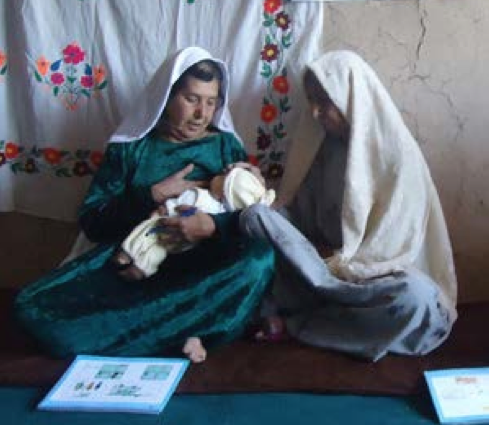
In Afghanistan, CHWs work in male and female pairs at health posts, frequently spouses or family members. Non-governmental organizations (NGOs) have contracts from the government in specific districts to supervise and train CHWs to implement the BPHS. At the present time, there are approximately 26,560 CHWs (12,965 females; 13,595 males).
Roles/responsibilities
Afghanistan’s CHWs provide a comprehensive package of services that includes health promotion, provision of certain health services, and referral to the next level of care. Importantly, CHWs are tasked with community case management of acute childhood illness (pneumonia, diarrhea, and malaria in endemic areas); treatment of patients diagnosed with TB; and the provision of family planning commodities.
 Training
The training of the CHWs lasts just over four months. They receive three separate three-week classroom and clinic modules. After the first two modules, the CHWs return to their villages for a month of practical
experience. The trainers attempt to visit all the trainees in their villages during these periods of field
experience.
Supervision
Each health facility supporting health posts has a Community Health Supervisor (CHS) that visits health posts to support and supervise the CHWs. In addition, the CHWs come monthly to the supporting health facility for a joint meeting with the other CHWs. During these encounters, the CHWs receive continuing education and have an opportunity to discuss problems encountered in day-to-day work.
Incentives and remuneration
Afghanistan’s CHWs are volunteers. Expenses for meetings and training are paid.
Impact
CHWs provide a major portion of primary health care services in Afghanistan. As such, they are widely recognized as important contributors to Afghanistan’s marked improvement in health status during the past15 years.
Author Affiliations
- Iain Aitken is an Advisor on Community-Based Health Care to the Ministry of Public Health, Afghanistan, through Management Sciences for Health from 2004 to 2015.
- Said Habib Arwal is Head of the Community-Based Health Care Department of the Ministry of Public Health, Afghanistan, since 2004.
- Anbrasi Edward is an Associate Scientist in Health Systems at the Johns Hopkins Bloomberg School of Public Health.
- Jon Rohde is an Emeritus Bernard Lown Professor, Harvard T.H. Chan School of Public Health.
Read more
Health for the People: National Community Health Worker Programs from Afghanistan to Zimbabwe
Leave a Reply