
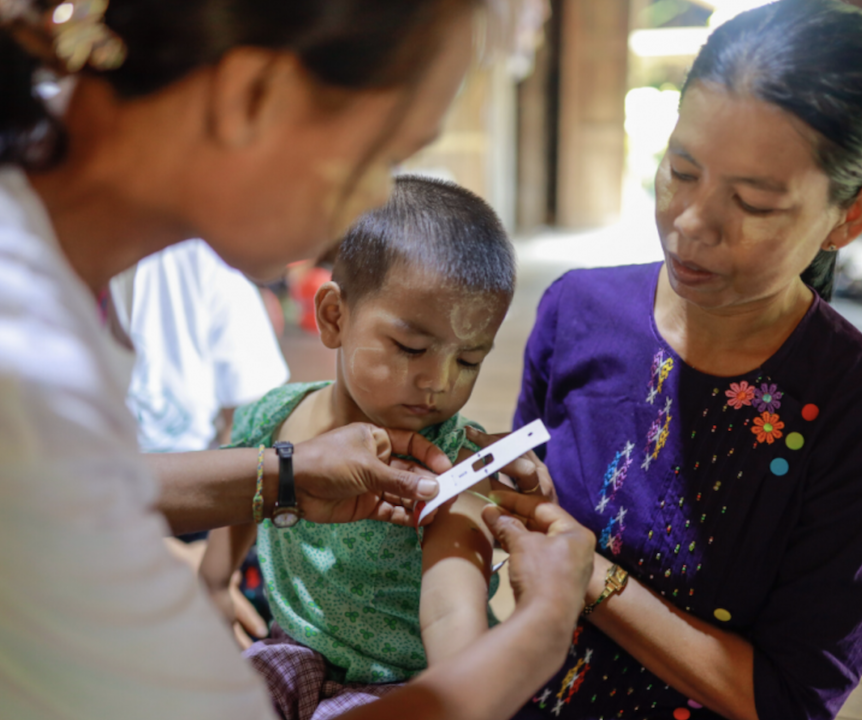
By: Alyssa L. Davs, Ye Myint Htwe, and Khin Htu Thet
Myanmar hosts a wide range of community health workers, including Malaria and TB Volunteers, Maternal Health Workers, and Village Health Workers. The government has invested significant resources into strategic planning to ensure that these workers cover the country’s most pressing public health challenges. Training length and intensity and the type of supervision varies based on topic and geographic area and worker roles. The National Health Plan (NHP) 2017–2021 promotes further integration of community-based health workers into primary health care planning.
Background
Auxiliary Midwives (AMWs) and Community Health Workers (CHWs) were first introduced in 1978 with the aim of bringing primary health care to the community level as a part of the government’s “Health for All” commitment. Other types of Community-Based Health Workers (CBHWs) were later introduced with national program and donor-supported project initiatives, most notably the widespread introduction of Malaria Volunteers and TB Volunteers from 2007 to 2011. Additionally, Ethnic Health Organizations (EHOs) have developed various types of CBHW cadres within their service delivery models, such as Maternal Health Workers and Village Health Workers.
Implementation
Myanmar has separate national strategic plans for each of the following five program areas: HIV, malaria, tuberculosis, newborn and child health, and reproductive health. All contain strategies for engaging communities and delivering services to the community level. Strategies include leveraging the various types of CBHWs for community mobilization, health education, and service delivery particular to each program. Non- governmental organizations (NGOs) and national selective programs may directly support CBHWs, but implementation often still involves some form of engagement with local health facility-based staff.
Roles/responsibilities
Roles and responsibilities for CBHWs vary by the type of cadre and typically include health promotion, disease surveillance, and referral services along with selected curative services. Routine activities vary to some extent according to the availability of donor support and priorities of the national program or organization providing support on a project basis to CBHWs in a particular geographic area.
Training
Topics and length of training for CBHWs vary by the type of cadre (e.g., AMWs receive 6 months of initial training, CHWs 1 month, and Malaria/TB Volunteers up to 1 week). Frequency of refresher training varies widely and depends largely on the donor, national program, or organization providing support on a project basis to CBHWs in a particular geographic area.
Supervision
Supervision varies widely in frequency and methodology across geography and programs, depending on arrangements with facility-based health staff, priorities of the national program or organization providing support, as well as the availability of funds for transport to enable supervision field visits or meetings.
Incentives and remuneration
Inconsistent monetary and non-monetary incentives are provided among the same and across different types of CBHWs. The greatest distinction is that AMWs and CHWs do not receive monetary incentives, while Malaria and TB Volunteers receive monetary incentives with funds from donors.
Impact
A number of program reviews and studies have documented the significant contributions of CBHWs to health promotion, disease prevention, and curative services in a range of contexts in Myanmar. CBHWs have been a part of the diverse mix of health workers extending primary health care to the community level for many years, but they are not fully integrated into the government’s budgets, operational plans, supply chains, and coordination mechanisms. Under the National Health Plan 2017–2021, the Ministry of Health and Sports (MOHS) has embarked on a plan to address these challenges.
Read more
Health for the People: National Community Health Worker Programs from Afghanistan to Zimbabwe
Leave a Reply