
By: Financing Alliance for Health (FAH)
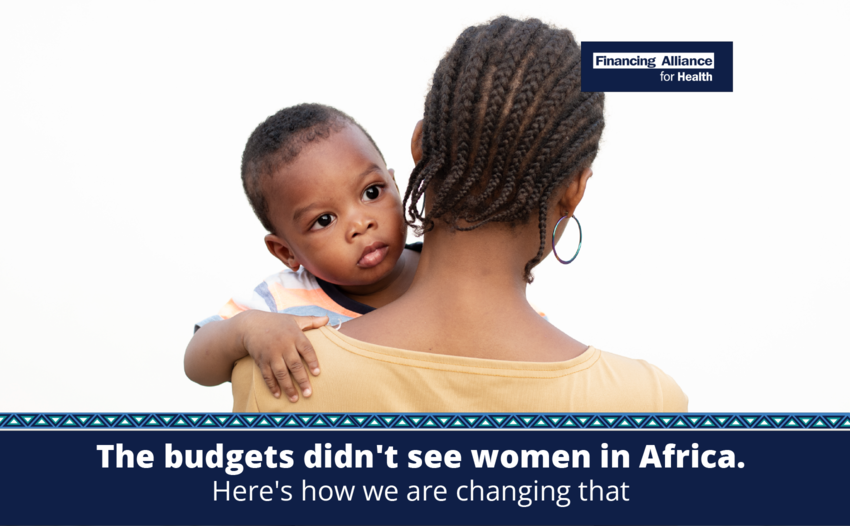
The budgets didn’t see women in Africa.
Here’s how we are changing that.
Sub-Saharan Africa (SSA) carries 70% of the world’s maternal deaths. The solutions are known. What is often still missing is a financing architecture that can see who is being left out – by sex, by location, by income – and route resources accordingly. With external aid – historically ~40% of health spending for RMNCAH across SSA – declining fast, stronger domestic resource mobilization, strategic purchasing and public financial management for RMNCAH is no longer optional. FAH supports government to build this architecture.
The scale of The issue

These numbers are not moving fast enough. The reason is structural: health financing is often designed without women in mind.
Health budgets across Sub-Saharan Africa were designed to fund services. They were not designed to ask: which women are not reaching those services, and why? And where is funding critically lacking to deliver the required level of quality?
This a technical bottleneck but the results are human. When a budget cannot disaggregate spending by sex, location, and income, it cannot identify the women who are dying during delivery due to late referrals; or the services that were not missed to ensure quality. When a ministry cannot link financial flows to health outcomes at district level, it cannot know whether the money it spent last year reached the women who needed it. When community health workers – predominantly women, predominantly unpaid – are invisible to the formal health system, the last mile of care is not supported to identify pregnancies early, ensure adherence to the antenatal schedule, identify danger signs and ensure vital post-natal visits happen. It also means that gender barriers that the first and second delays in seeking MNH care are not addressed and will remain fertile ground for inequalities and poor health outcomes.
External aid for RMNCH-N is projected to decline by 34% between 2023 and 2026, disrupting RMNCH services and making domestic resource mobilization the only sustainable path to health sovereignty.[5] Current financing models perpetuate these inequities by ignoring their structural roots; a gender-transformative pivot that is anchored in primary health care (PHC), community health systems and a strong use of data for outcomes is the most strategic and cost-effective path to closing the RMNCH gap.
1. Financing the MNCH Continuum of Care through Integrated PHC & Community Health Platforms
System Reform Objective
Ensure the entire MNCH continuum—ANC, PNC, skilled birth attendance, EmONC, family planning, adolescent SRH, essential newborn care—is costed, financed, and embedded in PHC and community health systems, with predictable public financing.
How FAH Strengthens This Area (Financing & Policy Examples)
- FAH supports Ministries of Health and Finance to cost integrated MNCH service packages and embed them in Medium‑Term Expenditure Frameworks and annual budgets.
- FAH strengthens strategic purchasing so MNCH interventions receive earmarked, formula‑based allocations at PHC and district levels.
- FAH advises governments on integrating community health financing (CHWs, commodities, referrals) into national budgets to secure frontline MNCH delivery.
2. Gender‑Responsive & Equity‑Driven Health Financing
System Reform Objective
Apply Gender‑Responsive Budgeting (GRB) and equity‑weighted financing to ensure resource allocation corrects gender gaps in access, quality, and financial protection for women, newborns, and adolescents.
How FAH Strengthens This Area (Financing & Policy Examples)
- FAH embeds gender equity markers into national health budget programs and supports countries to track MNCH spending by sex, age, wealth, and geography.
- FAH supports MoHs/MoFs to adopt GRB guidelines, ensuring financing flows target bottlenecks such as transport barriers, disrespectful care, adolescent needs, and GBV‑related access issues.
- FAH uses benefit‑incidence analysis and expenditure tracking to redirect funds toward underserved MNCH populations.
3. Sustainable Domestic Resource Mobilization for MNCH
System Reform Objective
Expand domestic fiscal space for MNCH through improved PFM, earmarked revenues (e.g., health levies), stronger pooling, more efficient insurance models, and de‑risked private capital.
How FAH Strengthens This Area (Financing & Policy Examples)
- FAH conducts fiscal space analyses and helps governments identify additional sources for MNCH financing (earmarked taxes, reduced waste, improved execution).
- FAH supports health insurance and pooling reforms to reduce catastrophic spending for pregnant women and newborns.
- FAH designs blended‑finance or de‑risking instruments that channel private capital into PHC/MNCH infrastructure, supply chains, and digital systems—always through government‑owned frameworks.
4. Real‑Time, Equity‑Centred Accountability & Data Systems
System Reform Objective
Build integrated digital systems that link financing to MNCH performance, track equity gaps, and elevate accountability from national to community level.
How FAH Strengthens This Area (Financing & Policy Examples)
- FAH helps governments integrate disaggregated MNCH indicators into national health information systems and budget review cycles.
- FAH develops district‑level budget + outcome dashboards that show where pregnant women, newborns, and adolescents are underserved—and guides reallocations in real time.
- FAH strengthens governance mechanisms such as community scorecards, participatory PHC budgeting, and transparency tools so MNCH financing is accountable to women’s voices
Why This Work Matters
A Triple Dividend on Every Dollar Invested
Every dollar invested in gender-responsive PHC and community health yields proportional returns across health, economic participation, and societal well-being.
Health Outcomes
Targeted PHC bundles can deliver a 54% decrease in maternal mortality.
Economic Outcomes
Scaling effective human resource for health interventions can add $12.5 trillion to global GDP by 2050.
Social Outcomes
Increased female labor force participation, enhanced community resilience, and reduced intergenerational poverty, and investing in women’s health reduces future healthcare costs and builds human capital.
This article was originally published on Financing Alliance for Health
Leave a Reply