
By: Diana Frymus
The complex and diverse challenges of CHW initiatives that emerge in a number of countries are invariably beyond the power of a single actor to address and require coordination and collaboration among different players and actors at all levels. (Muhammad Mahmood Afzal and Henry Perry)
This is the sixth chapter of the CHW Reference Guide, produced under the Maternal and Child Health Integrated Program, the United States Agency for International Development Bureau for Global Health’s flagship maternal, neonatal and child health project.
Summary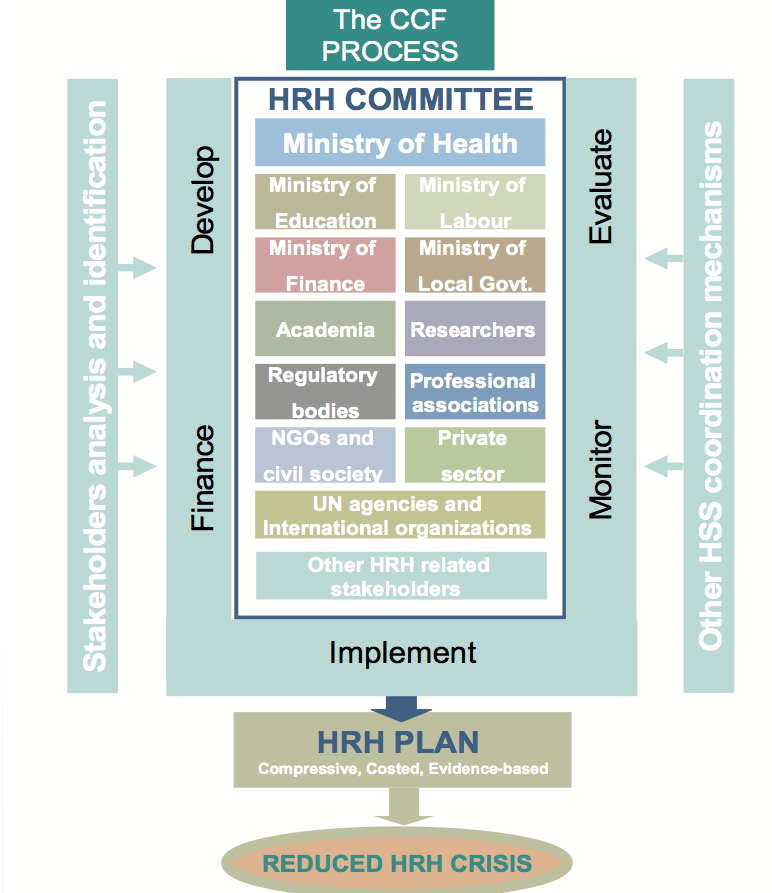
Fragmented country-level programming and utilization of CHWs contribute to the ambiguity of CHW program ownership and accountability. Chapter six recommends several existing coordination mechanisms and approaches that could guide harmonization of CHW support, such as the Country Coordination and Facilitation (CCF) approach for the human resources for health (HRH) agenda. (see framework at right; click to enlarge) It also presents an overview of the CHW Partner Commitment’s guiding principles and proposed framework to enable stronger alignment and integration of CHWs into national health systems and workforces.1 The chapter proposes that taken together, these approaches can provide a roadmap for coordination and partnership to strengthen the accountability of CHWs, their effectiveness, and sustainability as a cadre of the broader health workforce.
Reflection
This discussion is timely; CHWs continue to garner increasing global attention that brings greater urgency to the need for stronger coordination and partnership.2 The authors discuss CHWs within the complex human resources for health (HRH) stakeholder environment spanning multiple ministries, academia, professional councils, regulatory bodies, and more. CHWs represent only one type of cadre within a country’s health workforce, but the stakeholder landscape for CHWs is more complex. At the country level, entities that hold ownership and accountability for CHWs are often unclear, and the role of civil society and community constituents in placing CHWs within the communities they serve is also critical.
The global HRH agenda provides a central platform in which all players and stakeholders can come together to engage on CHW issues. The recent (2015) Addis Ababa Call to Action further demonstrates this opportunity.3 CHW performance is dependent upon the availability and accessibility of their facility-based health worker counterparts. These health workers, commonly designated as CHW supervisors, are also essential for providing care and services to clients who are referred by CHWs in the community. Achievement of universal health coverage (UHC) and global health goals requires greater focus on strengthening the entirety of the workforce and how it operates.
The 2013 CHW Partner Commitment drew attention to the need for stronger integration of CHWs into broader HRH efforts, although the extent of country-level implementation remains unclear. Ample opportunity remains across the current global health landscape for further utilization of the Commitment’s principles and framework for greater harmonization of efforts.
Conclusions
Chapter six suggests that existing platforms and thought leadership for addressing the challenges of fragmented CHW programming be utilized as a foundation for building stronger coordination and partnership for CHW initiatives. Within the current landscape for CHWs and HRH, the commentator suggests:
- Stronger coordination and partnership at both global and country levels. Globally, CHW partners across various initiatives and agendas need to coalesce around CHWs for better understanding of respective priorities and commonalities. Most likely challenges impeding CHW effectiveness and sustainability across agendas are very similar, if not the same. At the country level, alignment of support for CHWs is needed for enabling greater and more sustainable impact at scale. The key is to increase overall accountability and ownership for CHWs, avoid duplicity of efforts, and create greater efficiencies where there are limited resources.
- Greater utilization of existing coordination mechanisms to avoid the risk of further fragmentation of CHW efforts. Country-level landscape analyses should be conducted to identify existing coordination mechanisms to facilitate communication, decision-making, and sharing of data. Integrating CHWs within national health workforces, increasing engagement, and continuing to build capacity of existing platforms for human resources for health is critical.
- Greater engagement with the global HRH agenda. As the World Health Organization (WHO) continues to develop the new global strategy on HRH, there will be multiple opportunities to provide input and feedback. CHW players should increase their interaction with the global dialogue. This will be essential for greater recognition and focus on CHWs as countries and partners apply the new strategy to address the HRH challenges to achieving health goals and UHC.
 |
Diana Frymus is the Health Workforce Team Lead in the Office of HIV/AIDS at USAID in Washington, DC. She focuses on strengthening the health workforce to achieve HIV goals and sustain national HIV programs. She is the USAID co-chair of the PEPFAR HRH Technical Working Group and the Health Systems Global Technical Working Group on Supporting and Strengthening the Role of Community Health Workers in Health System Development. |
1. Commitment made at the 3rd Global Human Resources for Health Forum in 2013
3. Addis Ababa Call to Action on a High-Level Ministerial Meeting on Investing Human Resources for Health for Sustainable Development, 17 July 2015.
Leave a Reply